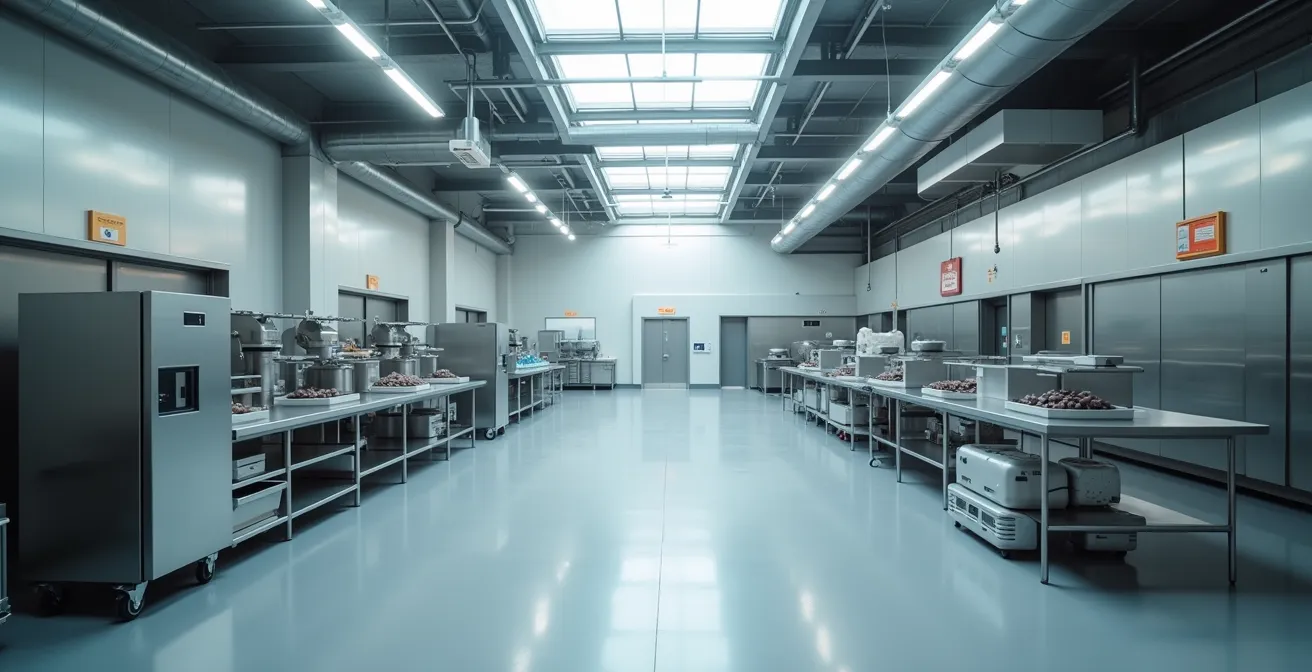
Ghost kitchen profitability isn’t about cutting rent; it’s about mastering a logistics-first operating system where every decision is a calculated input.
- Your menu must be engineered for delivery, treating packaging as a critical technology component, not an afterthought.
- Third-party app revenue is a trap without a parallel strategy for cultivating high-margin direct orders to control your bottom line.
Recommendation: Shift your mindset from ‘chef’ to ‘logistics manager’ to unlock the model’s true financial potential.
For entrepreneurs and restaurateurs eyeing the food industry, the ghost kitchen model appears to be the ultimate shortcut: all the revenue of a restaurant with none of the crippling overhead of a storefront. While the absence of front-of-house staff and expensive retail leases is a significant advantage, this is a dangerously simplistic view. Many operators dive in expecting easy profits, only to find themselves struggling with thin margins, operational chaos, and a crippling dependency on third-party platforms. They focus on the most obvious savings, failing to recognize they’ve entered an entirely new business paradigm.
The common advice is to “make food that travels well” and “get on all the delivery apps.” But this barely scratches the surface. The real challenge, and the real opportunity, lies in understanding that a ghost kitchen is not a restaurant without seats. It is a high-volume, logistics-first production facility that happens to make food. The core principles of success are borrowed more from e-commerce fulfillment centers and tech startups than from traditional hospitality. This requires a fundamental shift in thinking, where data analysis, supply chain efficiency, and digital brand building are more critical than decor and table service.
But what if the key to profitability wasn’t just reducing costs, but mastering a new kind of profit algorithm? This guide will deconstruct the operational physics of the successful ghost kitchen. We will move beyond the basics to explore how to architect a delivery-resilient menu, navigate the treacherous landscape of commission fees, optimize your physical and digital footprint, and build a scalable operational machine. The goal is to equip you with a consultant’s framework for building a profitable, delivery-only brand from the ground up.
This article breaks down the essential pillars for building a profitable ghost kitchen. From financial models to operational tactics, the following sections provide a strategic roadmap for navigating this digital-first food landscape.
Summary: Profiting from the Ghost Kitchen Model
- Why Ghost Kitchens Have Higher Net Margins Than Traditional Restaurants?
- How to Design a Menu That Survives a 30-Minute Delivery Ride?
- Single Concept or Virtual Food Hall: Which Maximizes Kitchen Efficiency?
- The Commission Trap: How to Maintain Profit on Delivery Apps?
- Where to Locate a Ghost Kitchen: Industrial Park vs. City Center?
- The “Hot Shot” Delivery: When Is It Worth the Extra Cost?
- Kitchen Bottlenecks: Why You Can’t Sell More Than Your Fryer Allows?
- How to Execute a Flawless Franchise Launch Timeline?
Why Ghost Kitchens Have Higher Net Margins Than Traditional Restaurants?
The primary allure of the ghost kitchen model is its profound impact on the bottom line. Traditional restaurants are burdened by the “three-legged stool” of costs: labor, food, and rent. The storefront model necessitates significant investment in front-of-house staff, prime real estate, and customer-facing amenities, all of which eat into profits. By eliminating the dining room, ghost kitchens surgically remove the largest and most volatile of these expenses. This lean operational structure fundamentally reshapes the profit and loss statement, creating a financial model built for resilience and higher returns.
The numbers are compelling. While a well-run traditional restaurant might celebrate a 3-9% profit margin, recent industry analysis shows ghost kitchens achieve 15-30% profit margins. This dramatic difference is a direct result of a drastically lower cost structure. Startup costs are a fraction of the traditional model—often $20,000–$30,000 compared to the $1 million or more required for a full-service restaurant. This lower barrier to entry not only democratizes access to the food industry but also accelerates the timeline to profitability. Many ghost kitchen operations can break even and achieve profitability within just 6 to 24 months, a timeline almost unheard of in the world of brick-and-mortar dining.
This financial advantage isn’t just about saving money on rent. It’s about reallocating capital. The funds that would have been spent on interior design, furniture, and a large service team can be reinvested into more strategic, growth-oriented areas. This includes higher-quality ingredients, sophisticated marketing technology, robust packaging solutions, and talent dedicated to operational excellence. The ghost kitchen isn’t just a cheaper way to run a restaurant; it’s a smarter financial engine designed for the digital age, prioritizing investment in the product and its delivery over the physical space.
How to Design a Menu That Survives a 30-Minute Delivery Ride?
In a ghost kitchen, your package is your storefront, and the 30-minute delivery window is your moment of truth. A brilliant dish that degrades in transit is a failed product. Designing a delivery-resilient menu is an exercise in “menu physics”—understanding how heat, moisture, and time interact to affect texture, temperature, and presentation. The goal is to create items that taste as if they just left the kitchen, even after a journey across town. This means prioritizing ingredients and cooking methods that hold up well over time. Braised meats, stews, curries, and rice bowls are inherently more stable than delicate fried items or composed salads with vinaigrette.
However, the true mastery lies in the packaging, which must be treated as a crucial piece of technology. The right container is not just a vessel; it’s an active component in preserving food quality. It must manage moisture, retain heat, and maintain structural integrity. For example, a perfectly crispy fried chicken becomes a soggy disappointment in a sealed plastic container that traps steam. The solution is a vented paperboard container that allows steam to escape, preserving the crunch. Conversely, a hearty pasta dish benefits from a foil pan with a board lid to retain heat and moisture without turning the contents to mush. Choosing the right material is a strategic decision that directly impacts customer satisfaction and repeat business.
The image below shows a macro view of a specialized fiber-based packaging material. Its intricate texture is designed specifically to manage moisture and maintain food integrity during delivery, showcasing how material science is central to the delivery experience.

This focus on technical packaging is a core tenet of the logistics-first mindset. The “unboxing experience” is the customer’s first physical interaction with your brand. A thoughtfully designed package that delivers a hot, fresh meal communicates quality and care far more effectively than any logo. It’s an investment that prevents negative reviews, reduces refund requests, and builds the loyalty necessary for long-term success.
Action Plan: Auditing Your Menu for Delivery Resilience
- Points of contact: Analyze every menu item’s “delivery journey”—from plating to the customer’s fork. Identify all points of potential degradation like sogging, cooling, and texture loss.
- Collecte: Inventory your current packaging. Does it match the food? Assess if you are using the right tools, such as vented containers for fried items or securely sealed options for saucy dishes.
- Cohérence: Test your packaging against key criteria: heat retention, moisture management (venting vs. sealing), structural integrity, and how it presents your brand.
- Mémorabilité/émotion: Evaluate the “unboxing” experience. Is it a generic container, or a thoughtful package that protects the food and reflects your brand’s quality and values?
- Plan d’intégration: Create a prioritized action plan. Replace ineffective packaging, test new materials for problematic items (like french fries or soups), and standardize the best solutions across your menu.
Single Concept or Virtual Food Hall: Which Maximizes Kitchen Efficiency?
Once the basic operational model is in place, a critical strategic question emerges: should you focus on perfecting a single, powerful brand, or build a multi-brand virtual food hall from a single kitchen? This decision has profound implications for marketing, operations, and revenue potential. The single-concept model offers the advantage of simplicity. You focus all your resources—marketing spend, inventory management, and operational training—on one brand. This allows for deep specialization, perfecting a small number of SKUs to achieve exceptional quality and efficiency. It’s easier to build a strong, memorable brand identity when your message isn’t diluted.
On the other hand, the multi-brand virtual food hall is a powerful strategy for maximizing kitchen asset utilization. By creating several distinct virtual brands operating from the same kitchen, you can target different customer segments and dayparts. For example, the same ingredients and staff could produce high-end salads for the lunch rush under one brand, and comforting pasta dishes for dinner under another. The key to efficiency is ingredient overlap. A well-designed multi-brand portfolio leverages a core inventory of ingredients across different menus, minimizing waste and simplifying supply chain management. This diversification also mitigates risk; if one concept underperforms, others can sustain the business.
Choosing the right path depends on your resources and strategic goals. A single concept is often the best entry point for new entrepreneurs, allowing them to establish a foothold and a reputation for quality. The multi-brand model is a more advanced play, ideal for experienced operators looking to scale revenue from existing kitchen capacity. The following table breaks down the core trade-offs.
This comparative analysis, based on insights from industry platforms, highlights the strategic choices involved. As a recent analysis of ghost kitchen business models shows, the decision impacts everything from startup complexity to long-term revenue potential.
| Aspect | Single Concept | Multi-Brand Food Hall |
|---|---|---|
| Startup Complexity | Lower – single menu to perfect | Higher – multiple brands to manage |
| Inventory Management | Simple – fewer SKUs | Complex but efficient with ingredient overlap |
| Marketing Investment | Focused on one brand | Distributed across brands |
| Revenue Potential | Limited to single audience | Multiple revenue streams |
| Operational Risk | Higher – dependent on single concept | Lower – diversified portfolio |
The Commission Trap: How to Maintain Profit on Delivery Apps?
Third-party delivery platforms like DoorDash and Uber Eats are a necessary evil for most ghost kitchens. They provide invaluable access to a massive customer base and handle the complex logistics of delivery. However, this access comes at a steep price. These platforms are not partners; they are marketplaces that charge significant fees for visibility and services. Falling into the “commission trap”—becoming completely reliant on these high-fee orders—is the single fastest way to kill your profitability, even with high sales volume.
The financial drain is substantial. According to market analysis revealing that commission fees ranging from 15% to 30% of order values can cripple a ghost kitchen’s margins. When you factor in additional costs for promotions and preferred placement, which can reduce margins by another 8-12%, the profit on each order can shrink to nearly nothing. A successful ghost kitchen is one that learns to strategically leverage these platforms for customer acquisition while aggressively building its own high-margin, direct-to-consumer (DTC) channels.
The strategy is “commission arbitrage”: using the platforms to find new customers, then converting them to your own direct ordering system for their second and third purchases. This means investing in a branded website or app with a seamless ordering experience. As Restaurant Growth Analytics points out, the financial incentive is clear:
Direct orders through branded websites typically yield 15-20% higher margins. Third-party platforms like DoorDash and Uber Eats generate 60-70% of orders but charge 15-30% commission. A successful ghost kitchen averaging $50,000 in revenue might pay $7,500-15,000 in platform fees.
– Restaurant Growth Analytics, Ghost Kitchen vs Cloud Kitchen Market Analysis
This doesn’t mean abandoning third-party apps. It means treating them as a marketing expense rather than your primary sales channel. Use tactics like including flyers with a QR code for a discount on the next direct order in every delivery bag. Run targeted social media ads to your delivery radius promoting your own site. The goal is to own the customer relationship and the data that comes with it, freeing your business from dependency on platforms that control both.
Where to Locate a Ghost Kitchen: Industrial Park vs. City Center?
For a traditional restaurant, location is about foot traffic and visibility. For a ghost kitchen, location is purely a question of logistics. The central decision revolves around a trade-off: the lower rent of a suburban industrial park versus the greater delivery efficiency of a dense city center. There is no single right answer; the optimal choice depends on your target market, delivery radius, and labor costs. An industrial park offers significant cost savings on rent, which can be a major advantage for a startup. However, this is often a false economy if it places you too far from your core customer base.
A location on the urban periphery means longer delivery times, which increases the risk of cold food and unhappy customers. It also means higher fuel costs and potentially lower driver availability, as couriers tend to cluster in high-demand zones. Your “logistical radius”—the area you can reliably serve with a high-quality product in under 30 minutes—should be the primary factor in your decision. A city-center location, while more expensive, offers unparalleled access to a dense population of potential customers. Shorter delivery routes mean faster service, better food quality, and higher driver efficiency, allowing for more deliveries per hour.
The cost difference can be significant, but must be weighed against revenue potential. As highlighted in a detailed cost analysis for ghost kitchens, renting a commercial kitchen can range from $2,000 to $10,000 per month. In high-demand urban areas like New York or Los Angeles, those costs can be even higher, with some hourly rentals starting at around $30 per hour. The right strategy is to map your target customer demographics and model the potential order volume against the increased real estate cost. Often, paying a premium for a location that is 10 minutes closer to 50,000 potential customers is a far more profitable decision than saving on rent in an area with a sparse population.
The “Hot Shot” Delivery: When Is It Worth the Extra Cost?
In a digital-first business, customer feedback is swift and public. A single negative review about a cold or late order can have an outsized impact on your brand’s reputation. While optimizing for efficiency is key, there are moments when a calculated, high-cost intervention is the most profitable move. This is the role of the “hot shot” delivery—a dedicated, expedited service used for service recovery or delighting high-value customers. It’s an expensive tool, but when used surgically, it can be a powerful investment in customer retention.
The standard delivery model relies on aggregated orders and algorithm-optimized routes, which is efficient but impersonal. A hot shot delivery breaks this model. It involves using a dedicated courier—sometimes even a manager in their own car—to rush a corrected order or a surprise freebie directly to a customer. The cost is high in terms of time and resources, but the return on investment can be immense. It turns a one-star review into a five-star story of exceptional service, transforming a detractor into a loyal advocate. This is especially critical in the early days of a brand when every customer experience helps shape your online reputation.
Knowing when to deploy this tactic is key. It’s not for every late order. It should be reserved for specific, high-impact scenarios. A data-driven approach allows you to identify the moments where the lifetime value of a customer justifies the added expense. The goal is not just to fix a mistake, but to demonstrate a level of commitment that third-party platforms cannot replicate, creating a powerful emotional connection to your brand. A strategic “hot shot” policy is a hallmark of a sophisticated, customer-centric ghost kitchen operation.
- High-Value Orders: Trigger for orders exceeding a set value (e.g., $100) to protect significant revenue transactions.
- Service Recovery: Deploy immediately following a major kitchen error or a second complaint from the same customer within a short period.
- VIP Customers: Use proactively as a “surprise and delight” tactic for your top 5% of customers to foster extreme loyalty.
- Critical Business Periods: Implement during a grand opening week or a major promotion to ensure flawless execution when first impressions matter most.
Kitchen Bottlenecks: Why You Can’t Sell More Than Your Fryer Allows?
One of the key efficiencies of a ghost kitchen is the streamlined labor model. With no front-of-house to manage, an entire operation can often be run by just a small, highly-focused team. Indeed, operational analysis shows that with a ghost kitchen, you can eliminate front-of-house labor costs, often requiring only 2-4 back-of-house staff compared to a traditional restaurant’s full team. This lean structure is a major contributor to higher margins. However, it also introduces a new kind of vulnerability: the physical production bottleneck. In a system stripped down to its essentials, the maximum output of a single piece of equipment can define the entire business’s revenue potential.
This is the concept of the “throughput ceiling.” Your sales are not limited by the number of tables you have, but by the number of orders your kitchen can physically produce per hour. And often, that limit is dictated by one specific station. If your best-selling items are all fried, your revenue is directly capped by the capacity of your deep fryer. No matter how many orders come in from delivery apps, you simply can’t sell more than your fryer allows. This single point of failure can bring the entire operation to a standstill during a peak rush, leading to long wait times, cancelled orders, and negative reviews.
Identifying and managing these bottlenecks is a core task of the ghost kitchen operator. It requires a detailed analysis of your menu, sales data, and workflow. If 60% of your sales rely on the fryer, you have three strategic options: invest in more fryer capacity, engineer your menu to distribute demand across other stations (like the griddle or oven), or use dynamic pricing and marketing to nudge customers toward non-bottleneck items during peak hours. A sophisticated operator thinks like a factory floor manager, constantly optimizing the production line to increase throughput and maximize revenue per square foot.
Key takeaways
- Profitability hinges on a logistics-first mindset, treating the kitchen as a production facility optimized for delivery.
- Packaging is a technology. Investing in materials that manage heat and moisture is as crucial as the ingredients themselves.
- Dependency on third-party apps is a margin killer. A robust direct-ordering channel is essential for long-term financial health.
How to Execute a Flawless Franchise Launch Timeline?
The ultimate expression of the ghost kitchen model’s power is its scalability. A successful, well-documented concept can be replicated and launched at a speed and scale unimaginable in traditional franchising. With a lower startup cost and a model less dependent on prime real estate, you can expand a brand’s footprint exponentially. However, this speed can be a double-edged sword. A flawless launch requires a meticulously planned timeline that coordinates supply chains, technology onboarding, and digital marketing with military precision. This is where the true “food tech” nature of the business comes to the forefront.
The MrBeast Burger launch is the quintessential case study in hyper-scaling a virtual brand. By licensing the brand to existing restaurants, they were able to activate 300 locations overnight, leveraging the existing infrastructure and labor of their partners. Within four months, they had sold over a million burgers. This model demonstrates that the most valuable asset is the brand itself, and a digital-first launch strategy can create massive demand before a single order is even placed. The key is a powerful combination of brand equity and a plug-and-play operational model that allows partners to easily add a new revenue stream.
Case Study: MrBeast Burger’s Explosive Launch
MrBeast Burger revolutionized the ghost kitchen space by opening 300 virtual locations in a single night. This “overnight sensation” was built on a licensing model, allowing existing restaurants to add the delivery-only concept to their operations. By utilizing their partners’ existing equipment, the model promised the potential for up to $500+ in additional daily profits. The strategy’s success, with one million burgers sold in under four months, proved that a powerful digital brand could be the primary driver of a massive, distributed food operation.
A flawless launch timeline must prioritize the digital infrastructure first. Before any food is cooked, the technology stack must be perfect: the point-of-sale system, the kitchen display system (KDS), and the integrations with all third-party delivery platforms. The marketing campaign must build anticipation and drive pre-launch sign-ups. The supply chain must be tested to ensure all franchise locations can receive consistent, high-quality ingredients from day one. Unlike a traditional opening where you can fix problems on the fly, a multi-location virtual launch is unforgiving. The brand’s reputation is built or broken across hundreds of digital storefronts simultaneously.
By shifting your focus from a traditional restaurant mindset to that of a logistics-driven, digital-first operator, you can build a highly profitable and scalable food business. The next step is to apply this framework to your own concept, starting with a rigorous audit of your menu, technology, and financial model.