
Scaling a service fleet isn’t about buying more trucks; it’s about eliminating the operational drag that silently drains your profits.
- Excessive “windshield time” is a primary profit killer, often consuming over 25% of a technician’s day if left unmanaged.
- Shifting from reactive to predictive systems for maintenance and inventory prevents costly downtime and unnecessary return trips.
Recommendation: Focus on optimizing job density and asset utilization before adding another vehicle to your fleet.
For many entrepreneurs running a mobile service business, growth feels like a paradox. You’re busy, the phone is ringing, and adding another truck seems like the logical next step. Yet, as the fleet grows from two trucks to five, and then to ten, profits don’t always scale accordingly. Instead, chaos multiplies. Schedules become tangled, technicians waste hours driving across town, and trucks are either missing critical parts or are overloaded with the wrong inventory. The familiar efficiency of a small operation evaporates into a fog of logistical friction.
The common advice is to get better software or hire more people. While important, these are symptoms, not the root cause. The fundamental challenge isn’t about managing trucks; it’s about the breakdown of ad-hoc processes that simply don’t work at scale. You can’t rely on memory or a simple calendar when coordinating ten or more moving assets, each with its own maintenance schedule, inventory, and driver.
The true key to scaling efficiently lies in a strategic shift in mindset. You must stop thinking like a small business owner and start thinking like an operations manager. This means treating time, distance, and inventory as quantifiable assets to be systematically optimized, not just costs to be absorbed. It’s about building robust operational systems that attack “operational drag”—the invisible waste that erodes margins with every unnecessary mile driven and every minute of downtime.
This guide will deconstruct the core systems you need to build. We will move beyond generic tips and into the logistical frameworks that enable profitable scaling, transforming your growing fleet from a source of stress into a finely-tuned engine for growth.
This article provides a comprehensive roadmap for building the operational systems your business needs to grow. Below is a summary of the key logistical levers you can pull to drive efficiency and profitability in your mobile service fleet.
Summary: How to Efficiently Scale Your Mobile Service Fleet
- Why Driving More Than 15 Minutes Between Jobs Kills Profit?
- How to Manage Maintenance Schedules for 10+ Service Vehicles?
- Commission or Hourly: Paying Drivers to Maximize Productivity
- The “Empty Truck” Mistake That Causes Return Trips and Delays
- When to Switch from Google Calendar to Dedicated Fleet Software?
- Night Drops vs. Day Deliveries: Which Minimizes Disruption?
- Too Big or Too Small: The Goldilocks Zone for Service Territories
- How to Reduce Fixed Overhead to Weather Economic Storms?
Why Driving More Than 15 Minutes Between Jobs Kills Profit?
In a mobile service business, the single biggest source of hidden cost is “windshield time”—the non-billable hours your technicians spend driving between jobs. When your fleet is small, a 20-minute drive seems like a minor inconvenience. But as you scale, this time compounds into a massive financial drain. It’s not just the cost of fuel and vehicle wear; it’s the opportunity cost of a technician’s labor. Every hour spent driving is an hour not spent generating revenue.
The operational drag becomes significant when travel consistently exceeds 15 minutes. According to field service operations analysis, a windshield time figure of 35% is a major red flag indicating poor routing and territory management. Top-performing companies keep this metric below 25%. For a fleet of ten technicians, reducing windshield time from 35% to 25% is the equivalent of adding another productive technician to your team without the associated overhead.
This lost time is often a symptom of a reactive scheduling system. A call comes in, and the nearest available technician is dispatched, regardless of whether it pulls them across town and away from a dense cluster of other potential jobs. This inefficiency is further magnified by traffic, unexpected delays, and last-minute schedule changes. As big construction firms have found, it’s easy to lose 15-20% of total work hours purely to travel, a staggering cost for which there is zero return.
To combat this, you must shift from a geographical mindset (“who is closest?”) to a logistical one centered on job density. The goal is to saturate small, profitable areas with work, minimizing travel between appointments. This requires a proactive approach to scheduling and routing, sequencing jobs intelligently to create a logical, efficient path for each vehicle throughout the day.
Ultimately, treating travel time as a key performance indicator (KPI) to be minimized is the first step toward building a scalable and profitable operational system.
How to Manage Maintenance Schedules for 10+ Service Vehicles?
When you have one or two trucks, maintenance is simple: you fix things when they break. This reactive approach becomes a catastrophic liability when managing a fleet of ten or more vehicles. An unexpected breakdown doesn’t just take one truck off the road; it cascades through your schedule, causing missed appointments, customer dissatisfaction, and overtime for other technicians. The cost of downtime isn’t just the repair bill; it’s the lost revenue and reputational damage. The key is to move from a reactive model to a predictive maintenance system.

This evolution typically happens in three stages: reactive, preventive, and predictive. Preventive maintenance, based on mileage or time intervals, is a good first step, but predictive maintenance is the goal for a truly efficient fleet. By using telematics data and AI, this system analyzes vehicle performance in real-time to predict failures before they happen. This allows you to schedule repairs during planned downtime, not during a customer emergency. The financial upside is significant, as studies on AI predictive maintenance implementation show a 25-30% reduction in maintenance costs and an ROI of 300-500% within the first two years.
The difference between these approaches is stark, not just in cost but in overall operational efficiency. A predictive model provides the data needed to optimize every aspect of vehicle health, as a recent analysis comparing maintenance strategies highlights.
| Maintenance Type | Cost Reduction | Breakdown Reduction | Efficiency Gain |
|---|---|---|---|
| Reactive | Baseline | 0% | 0% |
| Preventive | 8-12% | 15% | 5% |
| Predictive | 12% | 20% | 9% |
Implementing a predictive system requires centralizing all maintenance data. You need a single source of truth that tracks everything from oil changes and tire rotations to diagnostic trouble codes from each vehicle’s onboard computer. This data allows you to move beyond a generic manufacturer’s schedule and create a customized maintenance plan based on the actual usage and condition of each specific asset in your fleet.
By treating maintenance as a data-driven, proactive process, you transform your vehicles from unpredictable liabilities into reliable, revenue-generating assets.
Commission or Hourly: Paying Drivers to Maximize Productivity
How you compensate your technicians is one of the most powerful levers for influencing fleet productivity. An improperly structured payment model can inadvertently incentivize the wrong behaviors, such as rushing through complex jobs (pure commission) or dragging out simple ones (pure hourly). As your fleet scales, finding the right balance is crucial for aligning driver motivation with overall business objectives like efficiency, quality, and customer satisfaction.
There is no one-size-fits-all answer; the optimal model depends on the nature of your work. For businesses focused on quick, transactional jobs like simple deliveries, a pure commission model can be highly effective at maximizing the number of jobs completed per day. Conversely, for services that require complex diagnostics or high-stakes repairs, a pure hourly model ensures technicians take the necessary time to do the job right, prioritizing quality over speed. This stability can also lead to higher driver satisfaction and lower turnover.
For most scaling service businesses with a mix of job types, a hybrid model often yields the best results. This structure combines a stable hourly base wage with performance-based bonuses. This provides drivers with financial security while rewarding them for efficiency and productivity. As the Fleetio Fleet Management Team notes in their best practices guide:
Some of our customers incentivize drivers for achieving high fuel efficiency, performing fleet inspection regularly or exhibiting high driving performance
– Fleetio Fleet Management Team, Fleet Management Best Practices Guide
This highlights the power of tying bonuses not just to job completion, but to behaviors that support the entire operational system—like vehicle care and safe driving.
| Model Type | Best For | Productivity Impact | Driver Satisfaction |
|---|---|---|---|
| Pure Hourly | Complex diagnostic jobs | Moderate | High stability |
| Pure Commission | Quick transactional deliveries | High | Variable |
| Hybrid (Base + Bonus) | Mixed service types | Highest | Balanced |
The goal is to create a system where the driver’s financial success is directly linked to the operational efficiency of the fleet, creating a powerful, self-reinforcing loop of productivity.
The “Empty Truck” Mistake That Causes Return Trips and Delays
One of the most frustrating and costly forms of operational drag is the “empty truck” mistake. This occurs when a technician arrives at a job site only to discover they don’t have the specific part or tool needed to complete the work. The result is a return trip to the warehouse or a local supplier, which doubles the windshield time, delays the current job, and disrupts the entire day’s schedule. This single failure in inventory management can cost hundreds of dollars in lost labor and fuel.
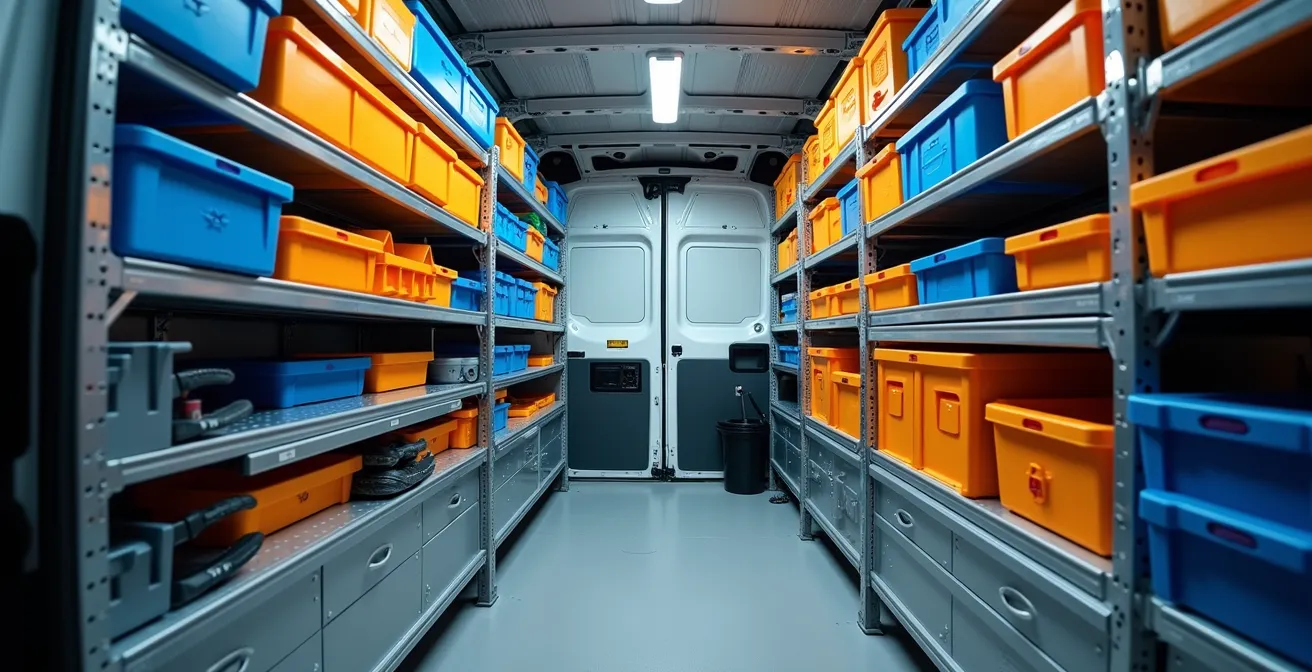
The problem is rampant; a National Institute for Automotive Service Excellence study reveals that technicians can spend up to 20% of their time just searching for necessary parts or tools. As a fleet grows, you can no longer rely on a “one-size-fits-all” stock list for every van. The solution is to build a predictive inventory system based on historical service data. By analyzing which parts are used for specific job types, you can create pre-assembled “job kits” that ensure the technician is equipped for the task at hand before they even leave the depot.
A sophisticated approach for larger fleets is the “Hub-and-Spoke” model. In this system, standard service vehicles carry a lean, optimized inventory for their most common jobs. One or more larger vehicles are designated as mobile “mini-warehouses” or “hubs.” These hubs are strategically positioned within service territories to resupply the “spoke” vehicles throughout the day, eliminating the need for long, inefficient return trips to a central warehouse. This requires real-time inventory tracking across all vehicles to work effectively.
Action Plan: Implementing a Hub-and-Spoke Inventory System
- Analyze historical service data to create predictive ‘job kits’ for specific service types.
- Designate one vehicle as a mobile ‘mini-warehouse’ to resupply field technicians.
- Implement real-time inventory tracking across all service vehicles to monitor stock levels.
- Establish a clear reverse logistics process for returning unused parts and old equipment.
- Regularly review data to refine job kits and optimize hub vehicle stock.
By shifting from a static stock list to a dynamic, data-driven inventory system, you can dramatically reduce return trips, increase first-time fix rates, and improve overall technician productivity.
When to Switch from Google Calendar to Dedicated Fleet Software?
For a business with one to three vehicles, Google Calendar and a spreadsheet can work surprisingly well for scheduling and tracking. It’s simple, free, and flexible. However, there’s a distinct tipping point where these manual tools become a significant liability, creating more problems than they solve. Continuing to use them past this point actively prevents your business from scaling efficiently. The key is to recognize the warning signs that you’ve outgrown your manual system.
The first major trigger is a loss of real-time visibility. If you can’t answer the question, “Where is everyone, and what is their status?” in under 30 seconds, your system is failing. You’re managing by phone calls and text messages, which is slow and prone to error. Another clear sign is fragility; if a single technician calling in sick requires hours of manual rescheduling and frantic phone calls to customers, your operational backbone is too weak. You’re not running a system; you’re just reacting to chaos.
Other critical triggers include:
- Excessive Planning Time: When manual route planning and job assignment for the day takes more than an hour or two, the administrative burden is too high.
- Data Silos: You’re tracking fuel purchases in one spreadsheet, maintenance records in another, and customer jobs in a third. There’s no way to connect these data points to see the true cost or profitability of a job.
- Customer Complaints: If complaints about late arrivals, inaccurate ETAs, or scheduling mix-ups exceed 5% of your jobs, your customer experience is suffering directly from your lack of a robust system.
When these triggers appear, it’s time to invest in dedicated fleet management software. These platforms integrate GPS tracking, dispatching, route optimization, maintenance scheduling, and reporting into a single source of truth. They automate the manual tasks that are consuming your time and provide the data needed to make intelligent, proactive decisions. This isn’t just a convenience; it’s a fundamental requirement for building a scalable operation.
The switch from a free calendar to paid software should not be viewed as an expense, but as an investment in the core infrastructure that will enable the next phase of your company’s growth.
Night Drops vs. Day Deliveries: Which Minimizes Disruption?
As your service fleet grows, scheduling becomes a powerful strategic tool. The timing of your service calls and deliveries can be optimized to not only improve your own efficiency but also to create a significant competitive advantage. A key decision is whether to stick to traditional daytime operating hours or to incorporate off-hours work, such as night drops or early morning restocking. The right choice depends entirely on your customer profile and can have a major impact on both cost and customer satisfaction.
For residential (B2C) customers, daytime or early evening appointments (4-8 PM) are often preferred, as they align with when homeowners are available after work. For business-to-business (B2B) clients, however, daytime service can be highly disruptive. A technician working in an office during business hours can interrupt employees, while service in a retail store can interfere with customers. In these cases, night or early-morning deliveries offer a premium, zero-disruption service model.
Implementing off-hours work, such as a “twilight shift,” allows you to bypass daytime traffic, significantly reducing windshield time and fuel costs. For example, a parts delivery fleet can restock retail locations between 5-7 AM, ensuring they are fully supplied before opening without a single service truck taking up a parking spot during business hours. While this may require paying a wage premium of 10-20% for off-hours labor, the efficiency gains and the value to the customer often provide a more than sufficient return. For instance, Wiseway Supply successfully shifted 40% of its deliveries to twilight hours, cutting traffic delays by 35% while ensuring driver safety with connected fleet technology.
This strategy transforms your fleet’s schedule from a simple constraint into a flexible asset. By matching your operating hours to your customer’s specific needs, you can minimize disruption for them and maximize efficiency for yourself, turning a logistical choice into a powerful market differentiator.
This level of strategic scheduling moves your operation beyond simply fulfilling orders and toward actively creating value through logistical excellence.
Too Big or Too Small: The Goldilocks Zone for Service Territories
Defining service territories is a classic challenge for a scaling fleet. Make them too large, and your technicians will waste their days on long drives, killing profitability. Make them too small, and you’ll leave profitable work on the table. The “Goldilocks Zone” is not about finding a perfect geographic size, but about adopting a dynamic approach to territory management based on a crucial metric: profitability per mile.
Instead of drawing circles on a map, you should calculate this KPI for different areas: `(Average Job Revenue – Travel Costs) / Miles Driven`. This data-driven approach reveals which neighborhoods or commercial zones are your most lucrative. It allows you to move beyond simple geography and focus on job density—the concentration of profitable work. An ideal urban territory might have a minimum threshold of 3-4 jobs per square mile, while a suburban one might only need 1-2 to be viable.
Effective territories are not static. They must flex with demand. A successful strategy involves seasonal territory adjustment, expanding your reach by 20% during peak season to capture all available work, and contracting it by 30% in the slow season to maintain job density and avoid sending technicians on long, unprofitable runs. This proactive management prevents your fleet from becoming overextended when business is slow.
Furthermore, a smart territory strategy includes a plan for handling profitable one-off jobs that fall outside your core zones. Instead of sending your own truck on a two-hour round trip, establish “frenemy partnerships” with trusted, non-competing local services. You can subcontract these outlier jobs to them for a referral fee, keeping the customer happy and your own fleet focused on its most profitable routes. This disciplined approach is critical, as modern fleet optimization technology demonstrates a 15-20% reduction in miles driven simply through better territory and route management.
By defining your territories based on profit density and allowing them to adapt to changing conditions, you ensure your fleet is always deployed for maximum financial return.
Key Takeaways
- Scaling a fleet requires shifting from ad-hoc management to building robust operational systems for travel, maintenance, and inventory.
- “Windshield time” is a primary profit drain; focusing on job density and intelligent routing is more critical than simply having the “closest” truck.
- Moving from reactive to predictive maintenance and inventory management transforms vehicles and stock from unpredictable liabilities into reliable assets.
How to Reduce Fixed Overhead to Weather Economic Storms?
As you scale your fleet, your fixed overhead—insurance, vehicle payments, facility costs—grows with it. While this is a natural part of expansion, a heavy overhead structure can make your business vulnerable to economic downturns or seasonal lulls. The ultimate goal of a sophisticated fleet operation is to build resilience by creating a more variable cost structure. This involves maximizing the revenue from every asset you own and adopting an “asset-light” scaling model where possible.
First, focus on maximizing the “Revenue per Asset.” Every vehicle is a cost center when it’s parked. An effective strategy is to convert fixed costs into variable ones. For example, switching to usage-based insurance models means your premiums are lower during slow periods. Another tactic is to turn your vehicles into revenue generators even when they’re on the road by implementing vehicle wrapping programs, which can generate an extra $300-$500 per month in advertising revenue. Even downtime can be monetized by using it for virtual training sessions to improve technician skills and future productivity.
Second, for handling peak demand, consider an asset-light approach rather than purchasing more vehicles that may sit idle for half the year. This involves building a network of vetted, reliable contractors or partner companies to handle overflow work. This strategy allows you to scale your service capacity up or down with demand, without taking on the long-term financial burden of owning and maintaining more trucks. As one large food and beverage fleet demonstrated, this model allows a business to service huge demand with significantly fewer owned assets, dramatically improving capital efficiency and improving customer uptime by 8% or more.
This strategic approach to overhead creates a business that is not only profitable during good times but also lean and resilient enough to withstand economic pressure. It’s the final piece of the puzzle in building a truly scalable and sustainable mobile service operation.
By focusing on asset utilization and a flexible cost structure, you can ensure that your business thrives in any economic climate, ready to seize opportunities for growth without being weighed down by its own success.